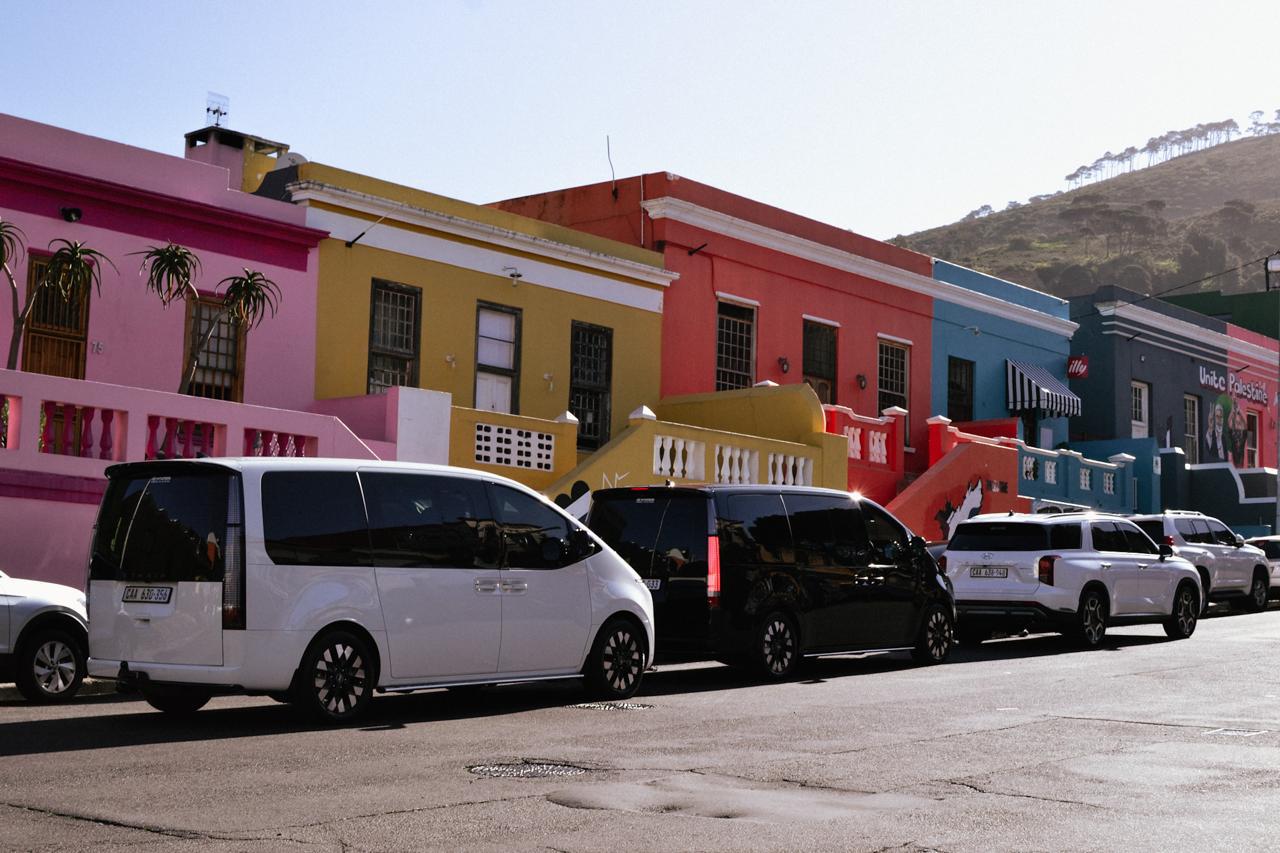
A study tour succeeds if the visiting officials can describe, a month later and in their own council chamber, how a housing project or a transport interchange in Cape Town works. Study tour transport in Cape Town supports that by keeping fifteen officials and their interpreter together across four stops, with two vehicles and two drivers on one full-day booking. The day is planned around the interpreter, because that is where the time goes.
Sixteen people and sixteen seats
Say fifteen municipal officials arrive from abroad to study housing and public transport, with one interpreter. That is sixteen people. A Hyundai Staria Luxury seats eight passengers, and two of them seat sixteen.
The count is exact, and exact is a warning. There is no seat for a host official who offers to ride along, and no seat for a local coordinator. If the host organisation is sending an escort, either the escort drives separately and meets the party at each gate, or a third vehicle is added. A Hyundai Palisade Elite seats six and brings the total to twenty-two. Decide this when the quote is requested. At 08:00 on the pavement it cannot be fixed.
Luggage is not a factor on a touring day. On arrival day it is. A full Staria takes around four large suitcases plus hand luggage, so sixteen people with bags for a week need more than two vehicles for the airport leg. How many vehicles a delegation needs works through that count.
One interpreter, two vehicles
Most study tour plans miss this. An interpreter can only be in one vehicle.
Whatever is explained on the road, by a host or a coordinator, reaches eight people and misses the other eight. Three practical rules follow.
- The interpreter rides with the head of delegation in the first vehicle on the way out, and changes to the second vehicle after lunch so both halves get a turn.
- Briefings happen on site, standing, with all sixteen out of the vehicles. Nothing that matters is said only in a moving cabin.
- The printed programme, with addresses and times, is in every delegate's hand in their own language before the day starts. Each driver has the same programme in English.
Then the timing. With consecutive interpretation, the host speaks and the interpreter repeats it, so everything is said twice. A briefing the host thinks of as 45 minutes takes closer to 90. Questions run the same way in both directions. A programme built on the host's estimate of each stop will be an hour behind by lunch.
A full day of four stops
| Time | Movement |
|---|---|
| 08:00 | Both vehicles at the hotel in the city centre. Headcount in each |
| 08:15 | Short drive to municipal offices in the city centre |
| 08:30 to 10:00 | Opening briefing on housing policy, interpreted |
| 10:10 | Depart for Khayelitsha, about 30 km |
| 10:45 to 12:30 | Housing project, site walk with the project team |
| 12:40 | Depart for Philippi, about 13 km and 15 minutes |
| 13:00 to 13:45 | Lunch at a community venue arranged by the host |
| 13:45 to 15:00 | Second housing site |
| 15:10 | Depart for Bellville, about 15 km and 20 minutes |
| 15:35 to 16:45 | Public transport interchange, with an official from the transport authority |
| 16:50 | Depart for the city centre, about 20 km |
| 17:40 | Hotel |
The route is about 80 km in a loop, well inside a full day's 250 km. The clock runs from 08:00 to about 17:45, close to the ten hours a full day includes. The last leg is timed generously on purpose. The N1 and N2 are busiest on weekday mornings and late afternoons, and weekday 17:00 is the most congested hour in the city.
When the second stop runs long
Suppose the Khayelitsha walk produces more questions than planned. Residents join the conversation, each exchange passes through the interpreter, and the party leaves at 13:00 where the plan said 12:30.
The coordinator has thirty minutes to find. Lunch is the obvious place and the wrong one, because the host has arranged it and people are waiting to serve it. The better cut is the interchange. It moves to a 16:00 start and loses fifteen minutes, and the party is back at the hotel at about 18:00. That is fifteen minutes past the booked ten hours, billed as overtime at the rate on the quote. The coordinator approves it in one sentence and the day carries on.
Set against that the cost of a late departure with transport ordered by the leg. Two vehicles booked for 12:30 at a project site have either waited half an hour or gone. Sixteen people who do not speak the local languages are then standing at a site gate while one person tries to arrange two replacement vehicles through an interpreter. Thirty minutes of good questions has turned into an hour of nothing, and the third stop is cancelled by phone.
Study tour transport in Cape Town: what to ask any operator
These questions apply to West Landau as much as to anyone else. A coordinator who puts them to three operators will learn what each one actually does.
- Will the same two drivers do the whole day, and every day if the tour runs longer?
- What happens to the price if a stop is added or the day runs over?
- Where do the drivers wait at a project site, and who tells them the party is ready?
- Can a chauffeur who speaks the delegation's language be arranged? West Landau can arrange a German, French or Mandarin-speaking chauffeur on request. For other languages, the interpreter stays the channel.
- Will you show your operating licence, the drivers' professional driving permits and your passenger insurance? West Landau shows all three on request.
Who should book something else
A group of more than 36 is beyond the West Landau fleet, which is five vehicles. A tour of forty or fifty officials needs a coach, and a coach has one real advantage for a study tour, which is that one interpreter with a microphone reaches everybody.
A team of four or five with a single site to see needs one vehicle for a half day, 5 hours and 100 km inside the metro, and should not pay for two vehicles and ten hours.
For anything from nine to thirty-six people, smaller vehicles have the advantage at the gate. A Staria turns in a residential street and parks outside a site office where a coach would block the road.
Common questions
Should the interpreter count as a passenger?
Yes. Count every person who will sit in a seat, including interpreters, escorts and photographers. Sixteen seats carry sixteen people, and the count is done before the quote.
Can the tour run over several days?
Yes. Consecutive full days are booked at a discounted daily rate with one dedicated driver per vehicle throughout. A four-day study tour for a public-sector team sets out a longer programme day by day.
What should delegates wear for site visits?
Closed, flat shoes and clothes that can take dust. Ask each host whether the site has rules of its own. Jackets and bags can stay in the vehicles, which the drivers do not leave.
Who pays entrance or parking fees?
Entrance fees and venue parking are for the client's account unless they are itemised on the quote. Fuel and tolls are included in the rate.
Send the concierge the dates, the exact number of delegates, interpreters and escorts, the hotel, and the draft programme with an address, a gate and a contact name for every stop. Mark which host's time estimate allows for interpretation. A written quote and booking reference follow, and the fleet is set out on the group transport page. The delegation run sheet gives a table you can copy for the programme.