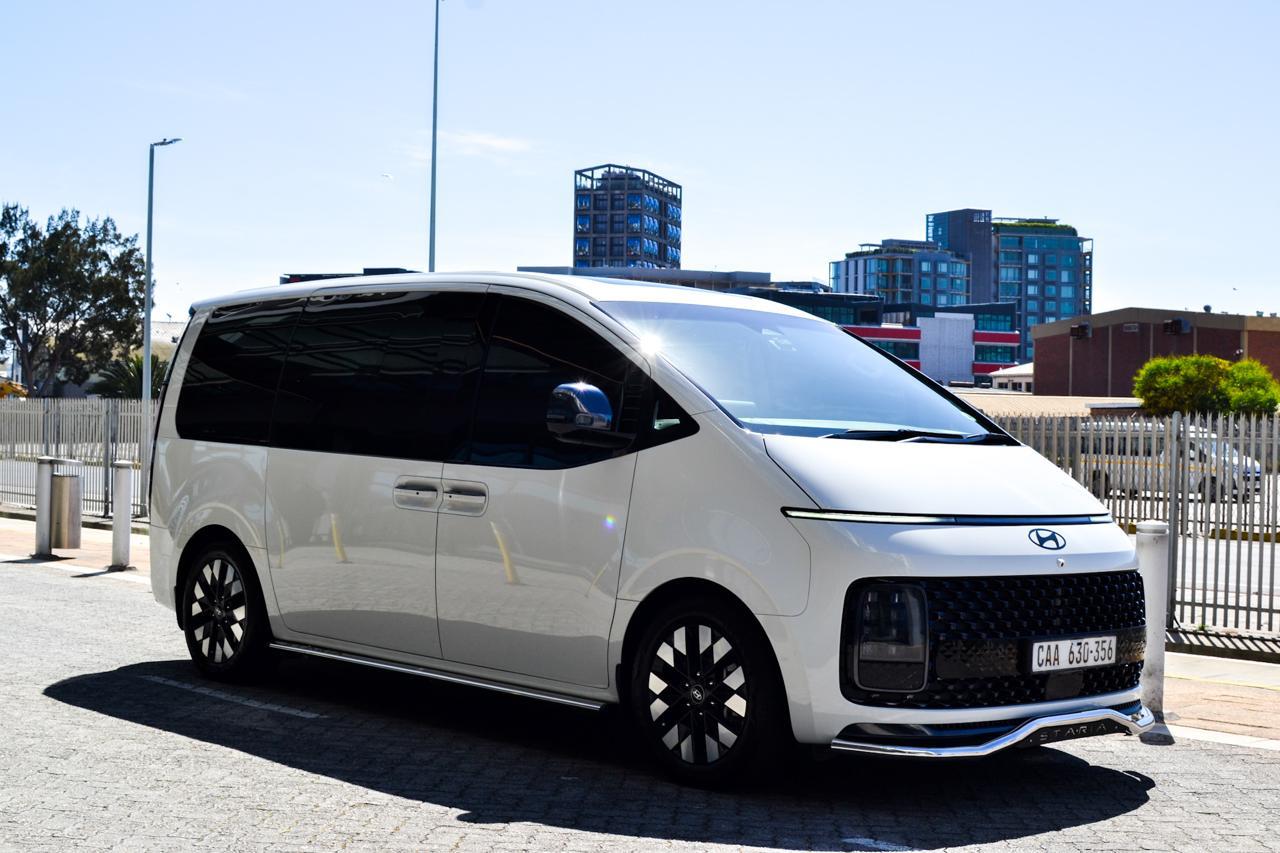
Review mission transport in Cape Town has to serve the document the mission leaves behind. By the last afternoon the team must have met the government counterparts, seen the sites and agreed its findings, and every hour spent waiting for a vehicle comes out of one of those three. A multi-day booking with one driver and one Hyundai Staria keeps the reviewers and their counterpart together, on time and working between stops.
Consider a review mission of five from a multilateral agency, in the Western Cape for three days. A government counterpart travels with them on the site days. This post takes the second day: a meeting at a provincial department in the city centre, a site in Bellville, a site in Paarl and a wrap-up at the hotel.
What the second day must achieve
Three outputs. The department meeting has to settle two open questions from day one. Each site visit has to give the reviewers enough to write a section of the findings. And by 18:00 the team leader needs a first draft of that day's notes, because day three is the report-back and there is no evening to spare.
The counterpart matters to all three. An official who rides with the mission hears the same explanations at the same time and can correct a misunderstanding in the vehicle, before it reaches the draft.
The run sheet for the day:
| Time | Stop | Detail |
|---|---|---|
| 08:00 | Hotel, city centre | Five reviewers board |
| 08:10 | Department building | Twenty minutes for the security desk, the visitor register and the lift |
| 08:30 to 10:15 | Department meeting | Driver waits nearby and returns on a message |
| 10:20 | Depart | Counterpart boards. Six of eight seats in use |
| 10:45 | Site one, Bellville | About 20 km from the centre, 20 to 25 minutes outside peak traffic |
| 12:30 | Depart | Lunch in the cabin or at a stop the counterpart suggests |
| 13:15 | Site two, Paarl | About 40 km further along the N1 |
| 15:15 | Depart for the city | About 60 km, 45 to 50 minutes outside peak traffic |
| 16:20 | Counterpart dropped at the department | |
| 16:30 | Hotel | Wrap-up from 16:45 |
| 17:30 | Booking ends | Vehicle released |
From 08:00 to 17:30 is nine and a half hours of a full day's ten. The distance is about 125 km of the 250 km included. Paarl sits outside the metro, which is one reason this is a full day and could never be a half day, whatever the hours.
Why the first twenty minutes are on the run sheet
A meeting at 08:30 on the sixth floor of a government building does not begin with arrival at 08:30. Six visitors sign a register, show identification, wait for an escort and share a lift. That takes fifteen to twenty minutes on a good day.
Mission schedules written from a head office often show the meeting time as the arrival time. Then the meeting starts at 08:50, the head of department leaves at 10:15 as planned, and the mission has lost a fifth of its only session with the decision-maker. The fix is to put the door time on the run sheet and treat the meeting time as something that follows from it.
The same applies to the drop-off point. "The department" is a building with more than one entrance. The brief names the street door visitors use and the person who will come down to fetch the party.
A late start, and where the day absorbs it
Say the head of department is held up and the meeting begins at 08:55. It runs to 10:40.
The team leader messages the driver, who brings the vehicle back to the same door for 10:45. The counterpart phones the Bellville site from the back seat. Site one starts at 11:10 and the lunch stop becomes sandwiches in the cabin on the way to Paarl. Site two still starts at 13:15. Twenty-five minutes have been taken out of lunch and nothing has been taken out of either site.
With cars booked leg by leg, the 10:15 car has gone by 10:40. A new one takes time to arrive, and six people need two. Site one starts closer to 11:30, the site host has a fixed commitment at 12:30, and the reviewers get an hour where they planned for an hour and three-quarters. That hour is one section of the findings written on thinner evidence.
The drive back is drafting time
Paarl to the city centre is about 60 km. In the cabin of a Staria there is Wi-Fi, privacy glass and room for six people to face the problem together. The team leader assigns sections on the way out of Paarl. By the time the vehicle reaches the department to drop the counterpart, the day's notes exist in rough form, and the counterpart has heard them.
Laptops and document bags stay in the vehicle at each site, with the driver. There is cold water after a site walk.
Review mission transport in Cape Town over three days
| Day | Programme | Booking |
|---|---|---|
| One | Opening meetings in the city centre | Full day |
| Two | Department meeting, Bellville and Paarl | Full day |
| Three | A third site in the morning, report-back in the afternoon, airport | Full day |
A multi-day booking runs at a discounted daily rate with one dedicated driver per vehicle. On day two that driver already knows which hotel door the team uses and that the team leader is always the last one out of a meeting. On day three nobody has to explain any of it again.
Cancellation windows apply to each day separately. If the third site falls away on day one, that morning can be changed more than 48 hours ahead without affecting the other days.
Limits, and who should not book this
West Landau supplies chauffeur-driven vehicles. It does not supply armoured vehicles, close protection or escorts, and its drivers obey the ordinary rules of the road. If the agency's own security office sets conditions for road travel, those conditions lead and the vehicle fits into them. Any specific requirement should go to the concierge in writing with the brief.
A mission whose meetings are all in one government precinct, with a hotel a few blocks away, should walk. A vehicle waiting all day outside one building serves nobody.
An agency that has its own vehicles and drivers in the country, and rules that require their use, should use them. A mission with more than eight in the party needs a second vehicle on the booking, and a delegation above 36 is beyond the fleet.
Common questions
Can a government counterpart travel in the mission's vehicle?
Yes. Rates are per vehicle, never per person, and a Staria seats eight passengers plus the driver. Whether an official may accept the lift is a question for the official's own department.
What if a site visit takes the day past ten hours?
Time beyond the booked hours is billed per hour at the rate on the quote. Decide before the mission who can approve it, and tell the concierge.
Can the mission be invoiced after the visit?
Confirmation is on full payment by EFT. Corporate and multi-day clients can be invoiced monthly on account by arrangement, which is worth raising at the quote stage.
Does the driver change between days?
No. On a multi-day booking each vehicle has one dedicated driver for the whole booking, and the team receives the driver's name, photo and direct number the evening before the first day.
Send the concierge the mission dates, the flights, the hotel, the number of reviewers and counterparts, and a draft programme with the street entrance and receiving person for each meeting and site. The concierge replies with a written quote and a booking reference. The run sheet format is covered in what the transport operator needs, site entry in gate access, inductions and where the driver waits, and the vehicles on the corporate chauffeur page.