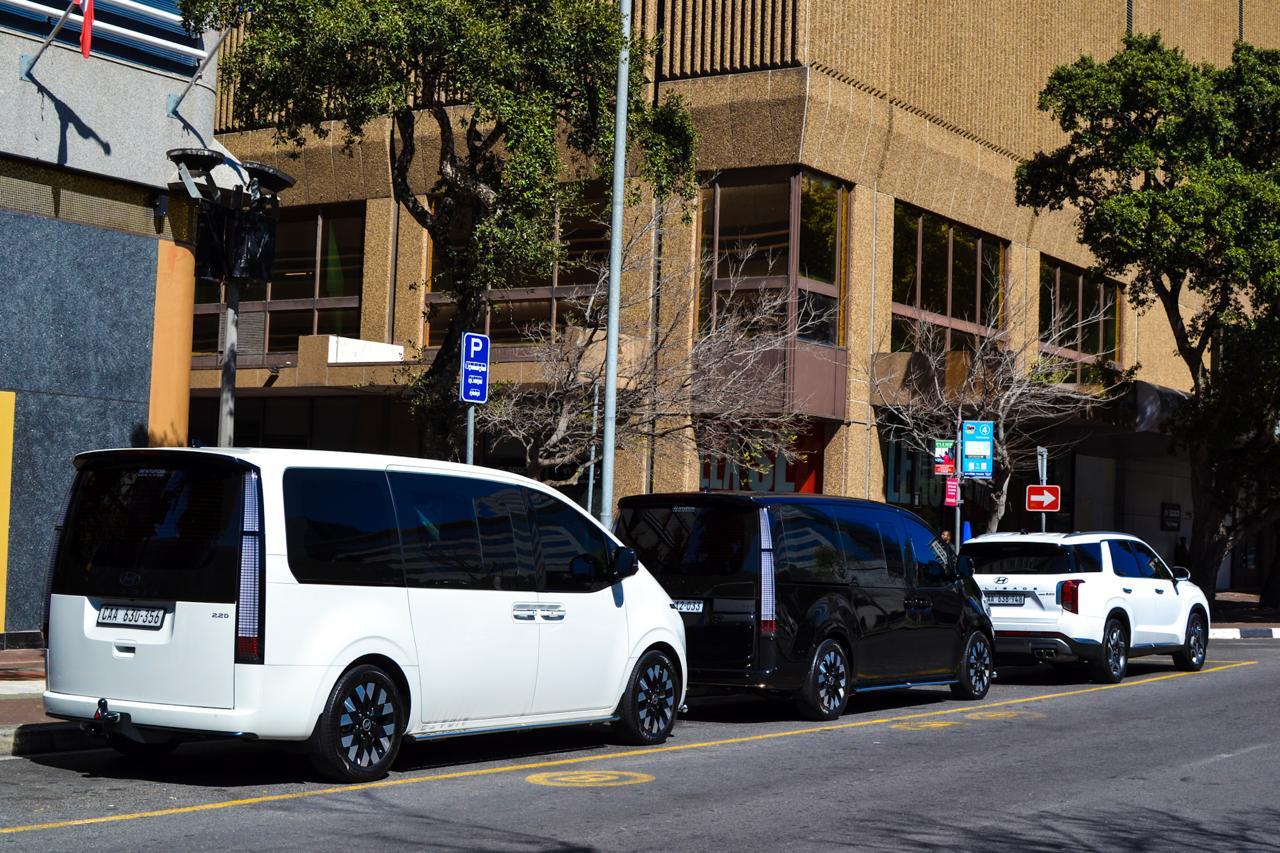
Trade delegation transport in Cape Town has one job: every delegate in every meeting on the programme, on time, with the vehicles still at the door when a visit runs long. For a party of eighteen that means three vehicles on a full-day booking, one driver each, all working from a single run sheet. A full day is ten hours and 250 km per vehicle, and a well-built programme uses nearly all of the first and less than half of the second.
A delegation day is measured in meetings held. A ministry has paid for the flights, each company has given up a week, and the hosts have cleared their diaries. If the transport costs the party one meeting out of five, a fifth of the day's purpose has gone.
The party, the seats and the spare ones
Take a delegation from a European trade ministry: fourteen officials, with four company representatives travelling alongside them. Eighteen people in all.
Two Hyundai Staria Luxury carry eight passengers each and a Hyundai Palisade Elite carries six. That is 22 seats for 18 people, and the four spare seats are deliberate. A host joins for one leg. An interpreter is added on the morning. Two delegates need to ride together to prepare the next meeting. A convoy with every seat filled has no answer to any of those.
The head of delegation rides in the Palisade with the people who need a word between stops. The Starias carry the rest, split so that each vehicle holds a complete group for the afternoon meetings. The rate is per vehicle, never per person, and the three are quoted as one booking. Who rides where is worth settling on paper before the day, and seating a delegation across two vehicles sets out the usual convention.
A full-day programme, timed
The programme below is an illustration. The stops are typical of what an inward delegation comes to see: a briefing in town, a manufacturer in the Atlantis Special Economic Zone, companies in Century City and an evening reception.
| Time | Movement | Notes |
|---|---|---|
| 08:00 | Hotel, Foreshore | All three vehicles at the door, loaded by 08:10 |
| 08:30 to 09:30 | Briefing, city centre | A few minutes from the hotel. Vehicles wait nearby |
| 09:45 | Depart for Atlantis | About 40 km, 40 to 45 minutes outside peak traffic |
| 10:30 to 12:30 | Manufacturer, Atlantis | Gate register and safety briefing come out of this slot |
| 12:30 | Depart for Century City | The run back is shorter than the run out |
| 13:15 to 14:15 | Lunch, Century City | Hosts from both afternoon companies attend |
| 14:30 to 15:30 | Meeting one, Century City | Delegation splits across two offices |
| 15:45 to 16:45 | Meeting two, Century City | |
| 17:00 | Depart for the V&A Waterfront | About 12 km, into the worst traffic hour of the day |
| 17:40 | Arrive, reception venue | Reception opens at 18:00 |
| 18:00 | Vehicles released | Ten hours from the 08:00 pick-up |
The arithmetic is plain. Ten hours on the clock, all ten used. Each vehicle covers roughly 100 km, against an allowance of 250 km. Time is the constraint on a day like this, and most of the time that goes missing goes missing at kerbs and gates.
The Atlantis visit overruns by 40 minutes
The factory tour was planned for two hours. The plant manager is proud of the line, the engineers in the party have questions, and at 12:30 nobody is walking to the gate. The visit ends at 13:10.
On a day booking, the three drivers are already at the visitor entrance with the engines running and the doors open. The party is on the road at 13:15 and in Century City before 14:00. The concierge has already told the lunch venue, because the delegation's coordinator sent one message at 12:35. Lunch is cut to half an hour and the 14:30 meeting starts at 14:30.
The same overrun on a string of separate transfers runs differently. The cars booked for 12:30 have a wait limit, and three of them now sit at a gate 40 km from town with their next jobs approaching. Somebody on the delegation spends the last half hour of the factory tour on the phone to a dispatcher. If one car leaves, six people are stranded in an industrial area where replacement vehicles are not around the corner.
| Three vehicles, one full-day booking | Separate transfers per leg | |
|---|---|---|
| Bookings to manage | 1 | 15 or more (five legs, three vehicles each) |
| Drivers briefed | 3, once | Up to 15, each knowing one leg |
| When a visit overruns | Vehicles are at the gate | Wait limits, rebooking, or a stranded group |
| Bags, samples and jackets | Stay aboard all day | Carried into every meeting |
What the drivers need before the day
The run sheet goes to the concierge the week before. For each stop it gives the street address, the gate or door, the name and mobile number of the person receiving the party, and the number of people going in. "Main entrance" is not enough for an industrial site with three gates. The delegation run sheet has a table to copy.
One person on the delegation speaks for it on the day, and changes go from that person to the concierge. The evening before, that person receives each driver's name, photo and direct number.
At a site like the Atlantis plant, ask the host two questions in advance: how long sign-in and the safety briefing take, and where three vehicles may wait. Twenty minutes at the gate is common, and it comes out of the visit unless it is on the run sheet. Gate access, inductions and where the driver waits covers the questions in full.
When this is the wrong booking
A delegation of forty needs a coach company. The West Landau fleet is five vehicles and 36 passengers, and that is the ceiling.
A programme held entirely in one hotel and the CTICC needs no vehicles at all. The two are a short walk apart, and an arrival and departure transfer covers it.
Eighteen people who move as one group all day, to two stops, with no split and no senior party travelling apart, may be content on a single minibus from a coach operator. Three vehicles are for the day that divides: two offices at 14:30, a head of delegation who leaves the reception early, a company representative with a separate meeting.
West Landau also supplies vehicles and drivers only. It does not supply armoured vehicles, close protection or police escorts, and its drivers obey the ordinary rules of the road. If the delegation travels with security staff, their plan governs and the vehicles fit into it.
Common questions
How early should a delegation book?
As soon as the dates and the party size are firm, even if the stops are still moving. The quote is built on vehicles and days. The run sheet can follow, and it should be closed the day before.
Can the three vehicles go to different places?
Yes. Each vehicle has its own driver and its own ten hours and 250 km. A split is planned on the run sheet, with a time and place where the convoy comes back together.
What happens after the reception?
The plan above releases the vehicles at 18:00. If the delegation wants them to wait and take the party back to the hotel, the extra time is billed per hour at the rate on the quote. Say so in the brief and it is priced beforehand.
Who pays for parking and site entry?
Fuel and tolls are included in the rate. Venue parking and any entrance fees are for the client's account unless they are itemised on the quote.
By 18:00 the delegation has held a briefing, seen a production line, sat down with two companies and walked into the reception together. To price a day like this, send the concierge the date, the number of delegates, the hotel and the draft programme. The reply is a written quote and a booking reference. Fleet details are on the corporate chauffeur page, and a visit of several days is covered in a five-day trade mission on one charter.