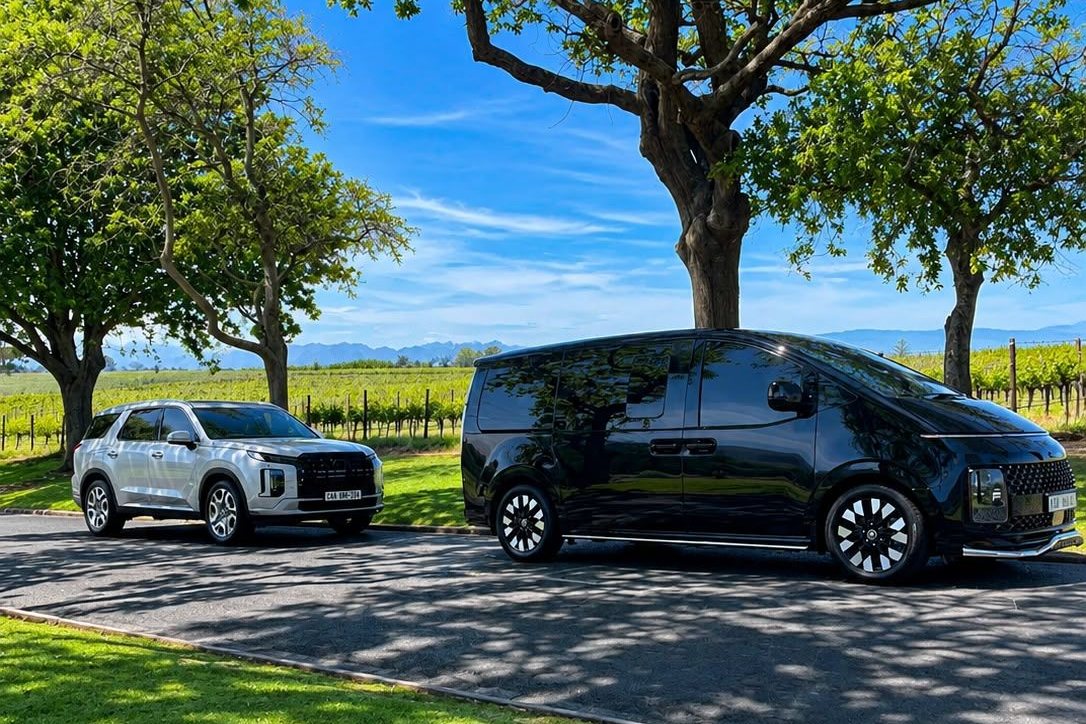
Fruit importers come to the Western Cape to follow the product from the tree to the ship, and they want to do it in one day so the chain makes sense as a chain. Agricultural delegation transport in the Western Cape has to carry twelve people over Sir Lowry's Pass to an orchard and a packhouse in the Elgin Valley, bring them back to a cold store, and get them through the gate of the Port of Cape Town before the afternoon is gone. Two Hyundai Starias on a full-day booking do it in about 160 km and under ten hours.
What the day must produce is confidence. Importers who have stood in the orchard, watched the packing line and seen the container stack have an answer for their own customers. Importers who saw two of the four have questions instead.
Twelve people, sixteen seats
Take ten fruit importers and two officials from the agency hosting them. Each Staria seats eight passengers plus the driver, so two vehicles give sixteen seats for twelve people.
The four spare seats are used. The grower's export manager rides from the orchard to the packhouse and talks the whole way. A bag of safety boots and a box of sample cartons need somewhere to sit. And when two importers want to finish an argument about pack sizes, they can change vehicles at the next stop without anybody being displaced.
One vehicle would be cheaper and would not work. Twelve people do not fit in eight seats, and parties of nine or more travel in two vehicles, one driver each, quoted as one booking.
The day, stop by stop
Deciduous fruit is one of the province's long-established export sectors, and the Elgin Valley, about 70 km from the city on the N2, is apple and pear country. The plan below is an illustration of how such a day runs.
- 07:00 Depart the hotel in the city centre. Early, so that the vehicles are leaving town while the traffic is coming in.
- 08:00 Arrive at the orchard, Elgin Valley. About an hour over Sir Lowry's Pass.
- 08:00 to 09:45 Orchard walk with the grower.
- 10:00 to 12:00 Packhouse. Hygiene briefing first, then the line.
- 12:00 to 12:45 Lunch in the valley.
- 12:45 Depart for Cape Town.
- 13:50 to 14:45 Cold store, on the way into the city.
- 15:00 Port of Cape Town, visitor gate.
- 15:10 to 16:15 Terminal visit with the port host.
- 16:30 Hotel.
On paper the day is nine and a half hours, with half an hour in hand. The distance is about 70 km out, about 70 km back and some 20 km between the farm, the packhouse, the cold store and the port. Call it 160 km of the 250 km a full day includes.
Closed shoes, hairnets and other things nobody mentions
Farm and food sites have rules, and visitors who do not meet them stand outside. Ask each host for the rules a week ahead and pass them to every delegate in writing. The usual ones:
- Closed, flat shoes. An orchard is uneven and a packhouse floor is wet. Someone in loafers or heels watches the packing line through a window.
- No jewellery, loose items or food on the packing floor, and a hairnet and coat issued at the door. Allow fifteen minutes for twelve people to sign a declaration, wash hands and dress.
- A health declaration at food sites. Anyone who has been ill may be refused entry, and it is better to learn that the night before.
- Cold-store temperatures. Twelve people in shirtsleeves last four minutes in a chilled chamber. Jackets stay in the vehicle until this stop for exactly that reason.
The drivers have the rules too, because they affect where the vehicles go. Some farms ask visiting vehicles to keep to the hard road and stay out of the orchard rows. The drivers park where the grower directs and wait there.
After the orchard there is dust on everyone. The cabin has chilled water and room to change shoes before the packhouse, and bags and laptops stay aboard between stops with the driver.
The port gate takes longer than planned
The plan allows ten minutes at the port gate. On the day it takes thirty-five. Two delegates' names are spelled differently on the visitor list and in their passports, and security checks each one by telephone.
This is where the half hour in hand is spent. The terminal visit starts at 15:35 and ends at 16:40, the vehicles are at the hotel by 16:55, and the day closes five minutes inside its ten hours. Nobody approved overtime because none was needed.
Now run the same delay through a cheaper arrangement: a transfer to Elgin in the morning, a second booking back to town, and e-hailing cars to the port. Twelve people need three or four e-hailing cars. Each must be cleared at the gate, or the party walks in from the public road. The port host, who had 65 minutes, now has 40. A fifth of the delegation's only look at the export terminal is gone, and it went at a boom gate.
A port is access-controlled, so settle these with the host before the day:
- Which gate takes visitors, by name.
- What each visitor must carry, and the exact spelling of names on the list.
- Whether the vehicle registrations and drivers' names must be submitted in advance.
- Whether the two vehicles may drive in, or the party transfers to a port vehicle.
- Where the drivers wait, and at which point the visit ends.
Send the answers with the run sheet. The concierge supplies the registrations and driver details for the host's list. The format is in the delegation run sheet, and the general case is covered in site visits: gate access, inductions and where the driver waits.
Is this the right transport for every farm visit?
No. A single agronomist spending three days on one farm should hire a car. A delegation of forty should hire a coach, because the fleet here is five vehicles and 36 passengers and a coach operator is the right supplier above that.
A day that adds a second valley is also a different booking. Elgin and the citrus country further north do not belong in the same ten hours. Split them, and look at a five-day trade mission on one charter for how consecutive days are priced and driven.
And where a programme has no farm at all, only meetings in town, the plan in trade delegation transport in Cape Town is closer to what is needed.
Common questions
Can the vehicles drive on farm roads?
On the made roads to the farm office and the packhouse, yes. Inside the orchard blocks the grower normally moves visitors on foot or in farm vehicles. Tell the concierge if the access road is long or rough.
How long does the drive to Elgin take?
About an hour from the city centre outside peak traffic, about 70 km on the N2 over Sir Lowry's Pass. Leaving at 07:00 keeps the vehicles ahead of the morning build-up on the way out.
Can importers take sample cartons back to the hotel?
Yes, within reason. A full Staria takes around four large suitcases plus hand luggage, and with six passengers in each vehicle there is space for a few cartons. Say how many when the brief goes in.
Does the rate change for two vehicles?
Each vehicle is charged at its own full-day rate, and the two appear on one quote and one invoice. Fuel, tolls, Wi-Fi and water are included in each.
By 16:55 ten importers have seen the fruit picked, packed, chilled and stacked for shipping, and they have had four hours in the vehicles to compare what they saw. Send the concierge the date, the party size, the hotel and the four site addresses with a contact at each. A written quote and a booking reference come back, and the drivers' names, photos and numbers arrive the evening before. The fleet is described on the corporate chauffeur page.