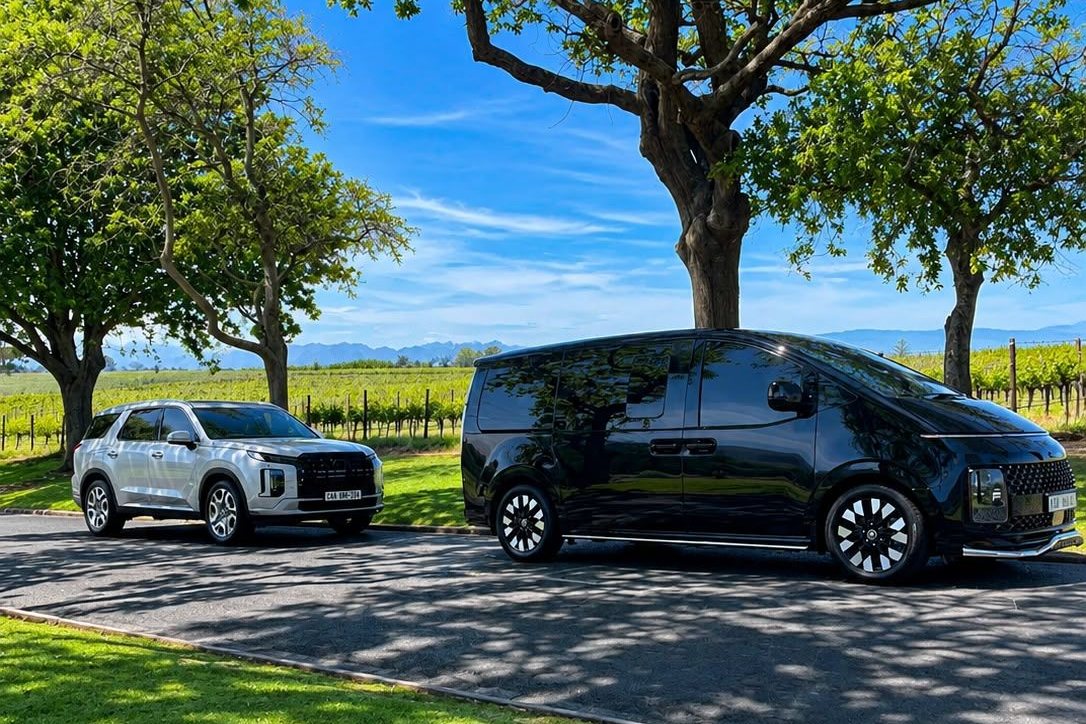
An offsite has two purposes that pull against each other. The group needs a full, uninterrupted day together, and the chief executive still has a company to run. Executive group convoy transport settles that by giving the principals a vehicle of their own that travels with the convoy when the programme is shared and leaves it when their day diverges. Twenty-eight people keep their afternoon. Three people make their call.
Where the 28 sit
Consider a company offsite at a venue outside Stellenbosch, about 50 km from the hotel in Cape Town. The party is a chief executive, two directors, a coordinator and 24 managers. The chief executive and both directors have a board call at 14:00 that has to be taken from the office in the city.
Four vehicles are booked. Three Hyundai Staria Luxury vehicles seat eight passengers each, which is 24 seats. One Hyundai Palisade Elite seats six. That is 30 seats for 28 people.
| Vehicle | Passengers | Seats used |
|---|---|---|
| Palisade, the leadership car | Chief executive, two directors, coordinator | 4 of 6 |
| Staria one | Eight managers | 8 of 8 |
| Staria two | Eight managers | 8 of 8 |
| Staria three | Eight managers | 8 of 8 |
Read the table critically. The two spare seats are both in the Palisade. Once it leaves at lunchtime, the group vehicles are full and there is no buffer at all. If a facilitator or a guest needs a ride back to town with the group, there is no seat. The fleet's fifth vehicle, a second Palisade, would fix that and bring the total to 36 seats. Whether the day needs it depends on one question the organiser can answer in advance: is anyone joining at the venue who did not arrive with the convoy?
The day, and the point where it splits
| Time | Movement |
|---|---|
| 07:45 | Four vehicles at the hotel. The Palisade stands first in line |
| 08:00 | Convoy departs for the venue, about 50 km |
| 08:55 | Arrive. The leadership car pulls in first and the host greets the chief executive |
| 09:15 to 12:15 | Morning session, all 28 |
| 12:30 | Lunch at the venue |
| 13:00 | Palisade at the side entrance. Chief executive, two directors and coordinator leave |
| 13:50 | Arrive at the office in the city |
| 14:00 to 15:00 | Board call |
| 14:00 to 16:00 | Afternoon session for the 24 managers |
| 16:15 | Three Starias depart for Cape Town |
| 17:15 | Group back at the hotel |
All four vehicles are on a full day of 10 hours and 250 km. The Starias run from 07:45 to 17:15 and cover about 100 km. The Palisade covers about the same distance and finishes earlier. Nothing comes near either limit.
Stellenbosch is about 45 minutes from the city outside peak traffic. A 13:00 departure for a 14:00 call leaves ten minutes in hand, enough to reach a desk and open a laptop. The coordinator rides along so that the room and the line are ready on arrival.
What the alternatives cost
Remove the leadership car and the chief executive has three ways to make the call. Each is worse than it looks.
The whole group can leave at 13:00. The afternoon session is lost. Twenty-four managers losing two hours is 48 working hours, and the session that was cut is usually the one where the morning's talk was to become a plan.
One of the Starias can take the three principals. Eight seats leave carrying three or four people. Twenty-four managers are left with sixteen seats, so eight of them have no way back until that vehicle has driven to the city and returned, a round trip of about 100 km.
Or the principals can request a car at 13:00 from a venue outside Stellenbosch. It may come quickly. If it takes twenty minutes, the board waits for its chief executive, and the call starts with an apology.
Against those, the leadership car costs one more vehicle on a day rate. The organiser can put a figure on 48 management hours and compare.
Moving as a convoy
A convoy of four vehicles is a small skill of its own. The points below are agreed among the drivers before 07:45, and the organiser should know them.
- Order. The leadership car leads on arrival at a venue where a host is waiting, so the right person steps out first. On the open road the order matters less than each driver having the full address and the gate.
- Separation. Traffic lights will split four vehicles. The drivers obey the ordinary rules of the road and do not run an amber to stay together. They regroup at a point named in advance, normally the venue gate.
- Arrival. The lead vehicle does not stop at the door until the others are in sight, so the host is not left greeting the party in instalments.
- Departure. The leadership car is parked where it can leave without moving another vehicle. At lunchtime it goes from a side entrance, without the whole terrace watching the principals walk out.
On the last point, the driver of the Palisade checks the exit when the convoy arrives. A leadership car boxed in behind three Starias in a gravel car park needs five minutes it does not have at 13:00.
The call moves to 13:30
At 11:40 the company secretary sends a message. A board member has a flight, and the call is brought forward half an hour.
The coordinator tells the Palisade driver, who has been with the vehicle since 08:55. The principals leave the session at 12:20 and are on the road by 12:30. Lunch for four is boxed by the venue and eaten in the vehicle. The cabin is quiet, the Wi-Fi is on, and the two directors go through the board pack on the way in. They are at the office by 13:20.
The 24 managers finish their session, eat lunch and may not know anything changed. That is what independence means in practice. A change to the principals' day costs the group nothing, and a group running late does not hold up the principals.
The vehicle as a working room looks at what can and cannot be done in the cabin between meetings, including when a call should be taken parked.
Who does not need a leadership car
A group whose senior people have cleared their diaries for the day should travel together. Sharing the ride is part of an offsite, and a separate vehicle that never leaves the convoy is an empty gesture.
A party of eight or fewer has one vehicle and nothing to separate from.
A group larger than 36 is beyond the West Landau fleet of five vehicles. A coach carries the main body, and a single Palisade for the principals can still run beside it. Moving a corporate group between venues covers planning a group day movement by movement.
Common questions
Should the leadership car be a different colour from the group vehicles?
It can be. Colour can be chosen from pearl, black or silver and is honoured subject to availability. A silver Palisade among Starias is easy for the principals to find. If discretion matters more, ask for matching vehicles.
Can the leadership car rejoin the group later?
Yes. After the call the Palisade can return the principals to the venue or bring them to the group dinner. It stays inside the day's 10 hours and 250 km on this programme.
Who gives the leadership car its instructions?
One named person, usually the coordinator or the chief executive's assistant. The group vehicles take theirs from the organiser. Two channels are kept separate so that a change for the principals is not broadcast to four drivers.
Is this executive group convoy transport priced per head?
No. Rates are per vehicle, with driver, fuel and tolls included, and four vehicles on one day are quoted as one booking.
Send the concierge the date, the hotel, the venue address with its gate, the number of people, and the names of those who travel in the leadership car with the time and place of any fixed commitment during the day. A written quote and booking reference follow, and the evening before you receive every driver's name, photo and direct number. The fleet is on the group transport page, and who sits where deals with seating inside each vehicle.