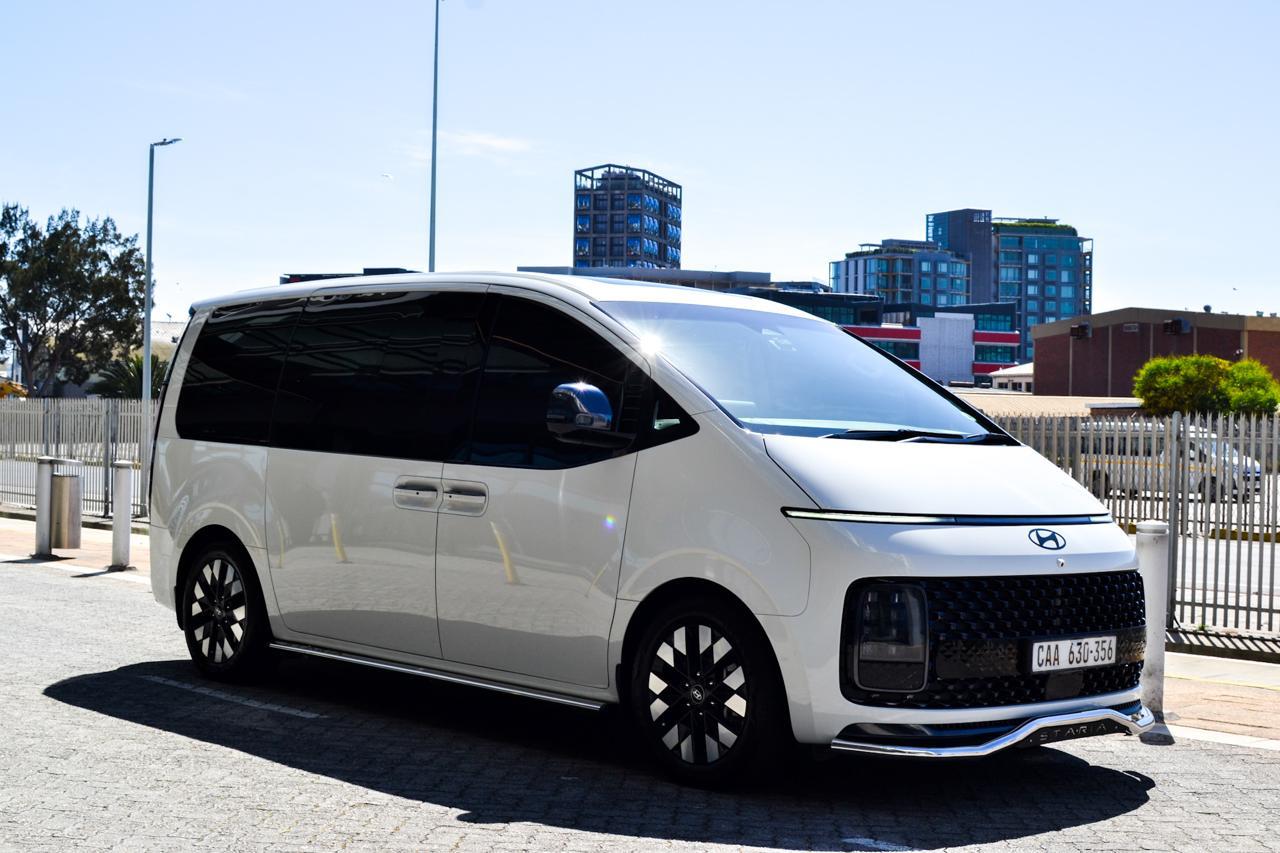
A multi-day full-day charter in Cape Town is a booking of consecutive full days, each of 10 hours and 250 km, with one dedicated driver per vehicle for the whole booking and a discounted daily rate. A visiting team books it so that the programme it planned is the programme it completes, without re-briefing a new driver each morning.
The detail below follows one worked example.
A multi-day full-day charter worked through: four days, one vehicle
Take a project team of seven with four days in the Western Cape. They have a partner to meet in town, two suppliers in the Winelands, a site in the Overberg and a closing session before the flight home. One Hyundai Staria Luxury carries eight passengers, so there is a seat over.
| Day | Where | Stops | Approx. km | Hours used of 10 |
|---|---|---|---|---|
| Day one | City centre, Century City, Bellville | Four meetings from 08:30, back at the hotel by 18:00 | About 60 | 9.5 |
| Day two | Stellenbosch and Paarl | Two suppliers and a working lunch | About 150 | 10 |
| Day three | Elgin Valley and Hermanus | A site in Elgin at 09:30, a meeting in Hermanus at 14:00 | About 260 | 10.5 |
| Day four | City centre, airport | Closing session 09:00 to 12:30, lunch, the airport by 15:00 | About 45 | 6.5 |
Day two uses the allowance exactly, day three exceeds it and day four uses two thirds of it.
What each full day of the charter includes
Every day of the booking carries the same inclusions as a single full day: the driver, fuel, tolls, Wi-Fi, chilled water and privacy glass. Rates are per vehicle, never per person.
The full-day allowance of 10 hours and 250 km covers the metro, the Winelands, Cape Point and the Whale Route to Hermanus. Hermanus is about 120 km from the city centre, about 1 hour 35 minutes over Sir Lowry's Pass.
Not included, unless itemised on the quote: entrance fees, tastings and venue parking.
When a day goes over
Day three is about 260 km and about ten and a half hours. Both are over. Time and distance beyond a full day's 10 hours and 250 km are billed at the quoted rates, per hour and per kilometre. Those rates are printed on the quote.
Two habits keep this from becoming an argument. Ask for the expected overage to be shown as a line when the programme makes it predictable, as it is here. And name one person in the party who can approve overtime on the day, so the driver knows whose word counts at 17:45 outside Hermanus.
Anything more than about 200 km from Cape Town, and any itinerary with an overnight stop away from the city, is quoted individually.
When a day comes in under
Day four ends at the airport after six and a half hours and 45 km. The natural question is whether the unused three and a half hours can be set against day three's overage.
Do not assume either way. If the programme has an obviously short day and an obviously long one, say so in the brief and ask how they will be treated, so that the answer is on the written quote.
A half day is 5 hours and 100 km inside the metro, so ask for day four to be quoted both ways.
Evenings
A full day is ten hours from the time it is booked to start. A day that begins at 08:00 ends at 18:00. A dinner that finishes at 21:30 is three and a half hours beyond that.
There are two ways to handle it. If nothing happens before late morning, book the day to start later, so that the ten hours cover the afternoon and the dinner. If the morning is busy as well, the evening is overtime at the quoted rate. A programme with a function every night, such as the one in a three-day official visit, should have that overtime agreed in advance.
The concierge desk is open every day until 21:00. After that, the contact is the driver's direct number, which is sent the evening before the first day with the driver's name and photo.
One driver, and what that is worth by day three
The booking has one dedicated driver per vehicle for its whole length. On day one the driver learns the hotel entrance, who sits where, how long the team takes to leave a building and which member of it is always on a call. By day three none of it needs saying. In the example, the Elgin site on day three has a gate and a visitor register. The driver has seven names ready because the same seven have been in the vehicle since day one.
Put a number on the alternative. Four separate bookings can mean four drivers. If each morning's introductions and instructions take ten minutes, that is forty minutes across the visit for seven people, close to five working hours in total. It also means four people outside the organisation have read the itinerary where one would have done.
How the driver's rest is arranged across a long booking, and where the driver stays if a day ends far from the city, are fair questions. Put them in the brief so the answers are on the written quote.
Cancellation, the rate and payment
Cancellation applies to each day
This is the term people most often misread. A multi-day charter is cancelled one day at a time. The windows are:
- More than 48 hours before that day's pickup: free, with a full refund or a new date.
- Within 48 hours: 50% of that day is retained.
- Within 24 hours, or a no-show: 100% of that day.
If the Hermanus meeting is called off on the morning of day one, day three is still more than 48 hours away. It can be shortened to Elgin alone, moved or cancelled without charge. The full wording is in the cancellation terms.
The discounted daily rate and how it is paid
Multi-day bookings run at a discounted daily rate compared with the same days booked singly. How the discount is calculated, and whether a minimum number of days applies, are questions for the concierge. Ask them in the brief.
A booking is confirmed on full payment by EFT. Clients on a corporate or multi-day booking can be invoiced monthly on account by arrangement. The guide to a corporate chauffeur account covers the account itself.
When single days or no vehicle are the better answer
A charter is for programmes that move every day. Test each day against one question: will the vehicle be used between the morning and the evening?
- A day spent wholly inside one venue does not need a full-day vehicle. Leave it out and ask how the gap affects the rate.
- A party of more than 36 is beyond the fleet of five vehicles.
For a single day, the comparison in one full-day booking or six separate transfers is the place to start.
How the charter looks for different visitors
The same terms carry very different weeks. A five-day trade mission uses three vehicles and splits them on the fourth day. A donor review returns to a site it has already seen. A chief executive's week includes a Saldanha Bay day that exceeds 250 km. A conference week starts its days late to cover the dinners. A two-week audit asks whether desk days need a vehicle at all, and a head-office visit keeps its free day on the booking.
Common questions
Can two or more vehicles be on one charter?
Yes. Parties of nine or more travel in two vehicles, each with its own dedicated driver for the whole booking, quoted as one booking.
Does the charter include airport transfers?
The arrival and departure can sit on the same quote and booking reference.
Is a private driver for a holiday the same thing?
The terms are the same. The leisure version is described in a private driver for several days in the Cape.
Send the concierge the dates, the number of people, the hotel, the flights and a plan for each day with addresses and times. List the questions from this post that matter to your organisation. The reply is a written quote, day by day, with a booking reference, and the corporate chauffeur page describes the vehicles.