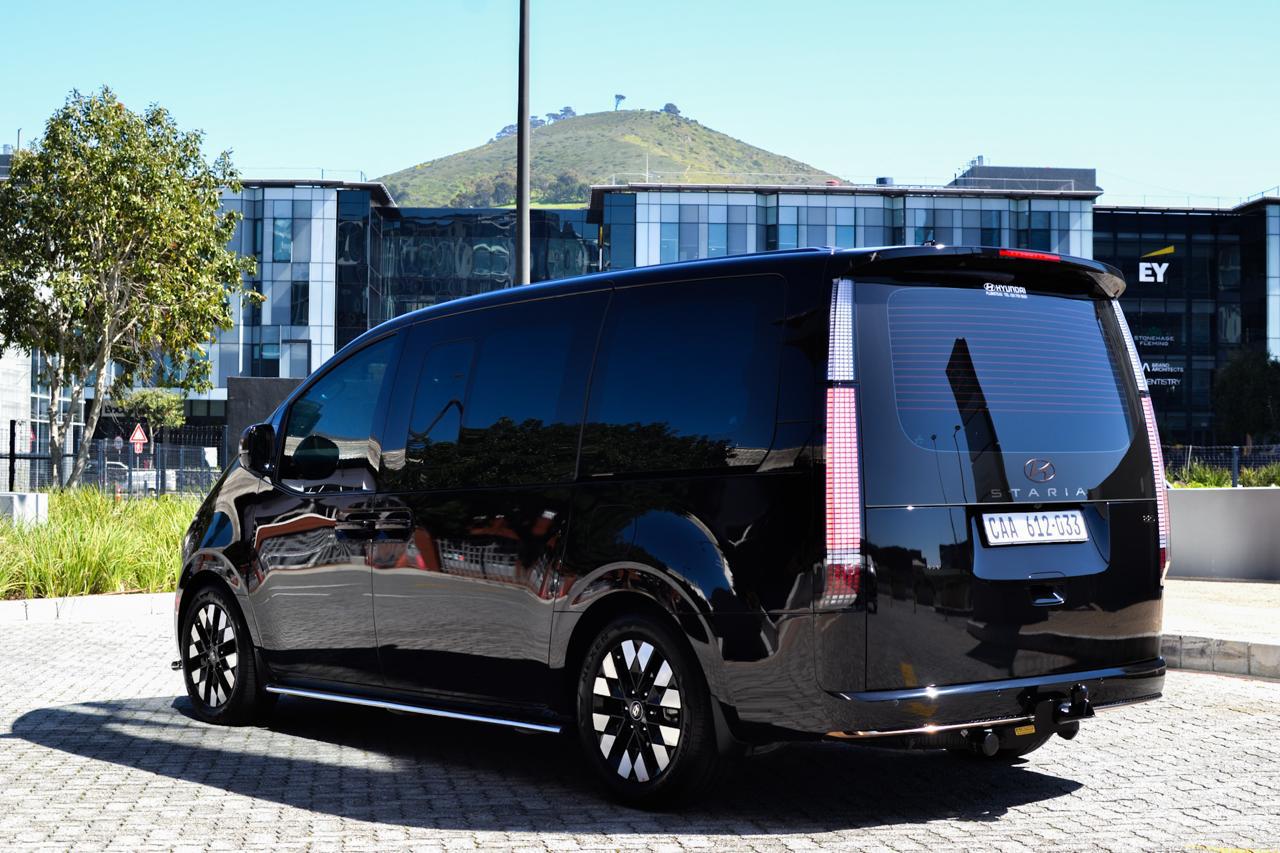
A mission that travels to Cape Town for the opening of the parliamentary year has a list to get through: the calls on members and committee staff that cannot be made from Pretoria, three receptions where the head of mission must be seen, and the address itself. Diplomatic mission transport for the Parliament week in Cape Town is best booked as one charter of five full days, one vehicle and one driver, because this is the week when the city centre is hardest to move through and a driver who learned it on Monday is worth most by Thursday.
Missions based in Pretoria often have business in Cape Town when Parliament sits. Take a team of four: a head of mission, a political counsellor, a trade officer and an assistant. One Hyundai Palisade Elite seats six passengers, which leaves two seats for a visitor from the capital or a guest on the way to a reception.
On dates: the State of the Nation Address is usually delivered in February. In 2026 it was held at Cape Town City Hall on 12 February. No 2027 date had been published by mid-November 2026, so the days below are given by weekday, with the address assumed for the Thursday.
Five days around the address
| Day | Where | Stops | Approx. km | Hours used of 10 |
|---|---|---|---|---|
| Monday | Airport, hotel, city centre | First flight down, three calls near the precinct from 11:00 | About 40 | 9 |
| Tuesday | City centre, Newlands, Waterfront | Two morning meetings, a consular colleague in the southern suburbs, reception from 18:00 | About 45 | 10, booked 10:30 to 20:30 |
| Wednesday | Stellenbosch, city centre | A university meeting at 10:00, lunch, two calls in town, reception from 18:30 | About 120 | 12, so 2 over |
| Thursday | City centre | Morning calls outside the closures, the address in the evening, a reception after it | Under 20 | See below |
| Friday | City centre, Century City, airport | A business breakfast, two follow-up meetings, the last flight | About 55 | 9.5 |
Thursday: where the vehicle cannot go
Roads around the parliamentary precinct and the venue close for the address. The City publishes a road closure notice beforehand, and that notice is the only reliable source. Check it when it appears, and do not plan from the previous year's map.
A mission should hear three consequences before it books.
First, the vehicle will not reach the door. Guests with invitations are told which entrance to use, and the last stretch is on foot or by whatever arrangement the organisers make for accredited guests. A chauffeur service has no standing to cross a closure. The drop-off point is the nearest legal kerb outside the cordon.
Second, the return is the harder leg. A large audience leaves at once, on foot, toward a small number of open streets. The driver and the head of mission agree a meeting point before the drop-off, a named corner with a landmark, and a fallback if that corner is closed. After 21:00 the concierge desk is closed and the contact is the driver's direct number, which the mission has had since Sunday evening.
Third, the day may not need ten hours of vehicle. If Thursday's morning calls are inside the closures or a short walk from the hotel, the honest booking for Thursday is the evening only. Ask the concierge to quote Thursday both ways. The closures are covered in more depth in SONA and Budget week.
Diplomatic mission transport in Parliament week: the case for a charter
The argument is strongest on the days either side of the address.
By Wednesday the driver has done the precinct four or five times. The visitor entrance to Parliament is on Plein Street. The driver knows where a vehicle may stop near it to let four people out, where it may not, and how long the security desk takes, so the head of mission is not delivered twenty minutes early to stand on a pavement or five minutes late to a committee chair. A driver booked for Wednesday alone starts from the map.
Then the receptions. Three evenings, three venues, each with a forecourt full of other missions' vehicles. The driver learns on Tuesday that the head of mission stays about forty minutes past the stated end and prefers to be collected from a side door. On Wednesday and Thursday that is simply done.
Fewer people hold the diary. A head of mission's appointments in Parliament week show who the mission is talking to. One driver sees it across five days. Five separate bookings could show it to five drivers and whoever dispatches them.
The rate is lower. A multi-day booking is charged at a discounted daily rate and keeps one dedicated driver with the vehicle throughout. If the mission needs to know how the discount is calculated for its own approvals, the question goes in the brief and the answer comes back on the written quote.
And the vehicle is secured. West Landau has five vehicles. The weeks around large events are booked early, and a vehicle requested on Tuesday for Wednesday may already be committed.
Parliamentary calendars move, which is the last argument. The cancellation windows apply to each day of the charter: a day cancelled more than 48 hours ahead is free, inside 48 hours half is retained, and inside 24 hours or for a no-show the full day is charged. If the mission learns on Monday that Friday's meetings have been folded into Thursday, Friday can be reduced to a departure or released without charge.
What five single bookings cost in this particular week
Use Wednesday. The team returns from Stellenbosch, about 50 km and 45 minutes from the city centre, for two calls in town at 14:30 and 16:00 and a reception at 18:30. With a new driver, each of the two drop-offs near the precinct involves a slow circuit to find where stopping is allowed that day. Say eight minutes each. The 16:00 call starts late, runs late, and the head of mission reaches the reception at 19:00, after the host's remarks.
Sixteen minutes of circling have cost the one moment of the evening that was on the record.
Limits that should be stated before the booking
West Landau supplies chauffeur-driven vehicles. It does not supply armoured vehicles, close protection officers, police escorts or blue-light driving. The drivers obey the ordinary rules of the road, including on the night of the address. Security decisions belong to the mission. If the mission has its own security officer, the routes and waiting points are shared beforehand and the vehicle fits into that officer's plan.
Questions about flag mounts, accreditation or anything a mission's protocol section requires go to the concierge with the brief. What protocol means at the kerb is described in diplomatic transport: what protocol means inside the vehicle.
When this is the wrong booking
If only the head of mission is travelling, for one day, the single-day pattern in an ambassador's working day in Cape Town fits better.
If the team's hotel is beside the precinct and every appointment before Thursday is inside it, the week needs an arrival, a departure and three evening bookings for the receptions. A vehicle that cannot enter the streets where its passengers are working is no use to them.
Common questions
Can the driver collect the head of mission from the aircraft side or the protocol lounge?
The pick-up point at the airport is agreed with the mission or its handler beforehand. For an ordinary arrival, the driver waits in the arrivals hall with a name board showing whatever the mission specifies.
How are the driver's rest hours handled after a late reception and an early start?
Ask in the brief, with the expected finishing times. The answer should be written on the quote.
Can the mission be invoiced?
Multi-day and corporate clients can be placed on account and invoiced monthly, by arrangement. Where there is no account, full payment by EFT confirms the booking.
Send the concierge the five dates, the flights, the hotel, the four names, the appointments known so far and the reception venues with their start and end times. Add the date of the address as soon as it is announced. The reply is a written quote, day by day, with a booking reference, and the vehicles are described on the corporate chauffeur page.