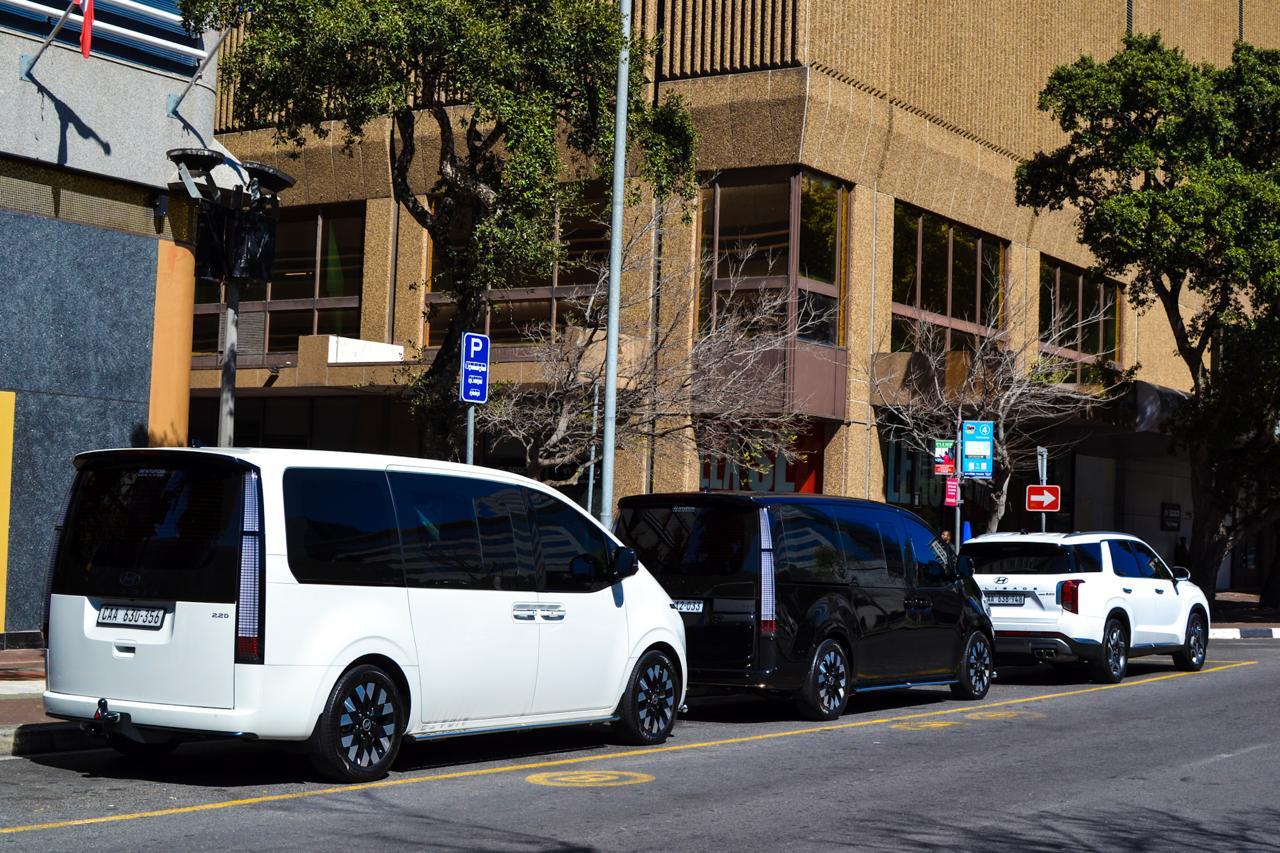
Conference field visit transport in Cape Town works when thirty delegates never arrive anywhere as thirty. The field day exists so that people who have spent three days hearing about projects can see two of them at work. Four vehicles on a full-day booking split the party into two groups that visit the projects in opposite order, so each host receives fourteen to sixteen visitors at a time and can still run its morning.
Say a conference at the CTICC ends on a Thursday. Thirty delegates have signed up to visit two projects on the Friday, one in Philippi and one in Khayelitsha. The organiser has one member of staff for the day, and several delegates fly out that evening.
What the field day is for
The delegates want to understand the work well enough to fund it, copy it or write about it. That takes conversation with the people who run it, in small enough numbers to hear the answers.
Thirty people stepping off one coach at one gate do not get that. A project with six staff cannot host thirty visitors and keep working. It stops, lines up and presents. The delegates see a presentation, which they could have seen at the conference. The staggered plan below costs more vehicles than a coach and gives every delegate nearly two hours at each project in a group the host can talk to.
Seats first: four vehicles for thirty people
Three Hyundai Starias seat eight passengers each and one Hyundai Palisade seats six. That is 24 plus 6, which is 30 seats for 30 delegates.
There is no spare seat in that sum. If the organiser's staff member, a host or an interpreter rides along, the fifth vehicle is needed. All five vehicles together seat 36, and that is the ceiling. A field day for forty is beyond the fleet, and the right answer is a coach operator or a second day.
The groups follow from the vehicles:
- Group A: two Starias, sixteen delegates.
- Group B: one Staria and the Palisade, fourteen delegates.
Each vehicle has its own driver, and the four are quoted as one booking.
Conference field visit transport on a staggered plan
| Time | Group A, 16 delegates | Group B, 14 delegates |
|---|---|---|
| 08:00 | Board at the hotel | |
| 08:10 | Board at the hotel | |
| 08:30 | First vehicle arrives, Philippi project | |
| 08:35 | Second vehicle arrives | |
| 08:50 | First vehicle arrives, Khayelitsha project | |
| 08:55 | Second vehicle arrives | |
| 10:30 | Depart for Khayelitsha | |
| 10:45 | Depart for Philippi | |
| 10:50 | Arrive, Khayelitsha project | |
| 11:05 | Arrive, Philippi project | |
| 12:45 | Depart for the city | |
| 13:00 | Depart for the city | |
| 13:15 | Lunch venue, city centre | |
| 13:30 | Lunch venue, city centre |
After lunch the vehicles work as a pool. Two Starias return sixteen delegates to their hotels at 14:30. The Palisade takes six to the airport at 15:00 and the third Staria takes eight at 16:00, each as the last leg of the day booking.
Philippi is about 20 km from the city centre and Khayelitsha about 30 km, 20 to 30 minutes each outside peak traffic. The groups cross on the road between the two projects at about 10:45, so each host has a short gap between one group leaving and the next arriving.
The airport is about 20 km from the centre. The vehicle that makes the 16:00 airport run is the last to finish, at about 16:30. From 08:00 that is eight and a half hours of a full day's ten. No vehicle covers more than about 90 km of the 250 km included.
How each vehicle arrives
Two vehicles five minutes apart, never together. The first carries the group lead, who has the host's name and number. Eight people step out and are met. The vehicle moves to the waiting place the host has named and the second pulls in.
Each host is asked the week before where vehicles should stop, where they should wait and how many visitors can stand in one room. The drivers stay with the vehicles, engines off, and bags and conference lanyards stay aboard. More on this in arriving at a community project.
A detail that saves ten minutes: delegates keep the same vehicle and the same seat all day. The driver counts heads against a list at every departure, and the group lead confirms the count before the door closes. With fixed vehicles a missing delegate is noticed in one minute. With open seating across four vehicles it takes a phone call to each.
What happens when one visit runs over
Group A's hosts in Philippi are generous with their time and the visit ends at 11:10, forty minutes late.
Group B is due at the same project at 11:05. The group lead for A messages the concierge at 10:30, and B's drivers are told to hold. Group B leaves Khayelitsha at 10:45 as planned and its two vehicles wait a few streets from the Philippi project until A's have pulled away. B starts ten minutes late and still leaves at 13:00. Group A reaches Khayelitsha at 11:30, and its second visit is trimmed to end at 12:55. A's lunch moves by ten minutes. Both airport runs leave on time.
A single coach cannot do this. Every delay is carried by all thirty to the end of the day, and the delegates with flights are the ones who pay for it.
Is a coach the better answer?
Sometimes, yes. If both hosts say they can receive thirty people at once, have space for a coach to stop and would prefer to do one session and be done, book a coach. It is one vehicle and one driver, and it will cost less than four.
The four-vehicle plan is for hosts who cannot or should not take thirty at a time, which describes most projects that operate from a house, a hall or a small centre. Ask the hosts before deciding. Their answer settles it.
For a party of fewer than nine, the field day is one Staria and the planning in donor site visits in Cape Town applies.
Common questions
Can thirty people travel in West Landau's vehicles?
Yes, in three Starias and one Palisade, with every seat used. Thirty-six is the limit across all five vehicles.
Why not send all four vehicles to one project together?
Because the host then receives thirty people at once, which is what the stagger is designed to avoid. Two groups in opposite order give each project fourteen to sixteen visitors at a time.
What does the organiser pay for?
Rates are per vehicle, never per person, and include the driver, fuel, tolls, Wi-Fi and chilled water. Lunch, entrance fees and venue parking are for the client's account unless itemised on the quote.
Can delegates with flights be dropped at the airport?
Yes, as the last leg of the day booking. Give the flight times with the brief so that the airport runs are planned before the day starts.
The brief goes to the concierge with the date, the hotel or hotels, the final delegate list split into two groups, each project's address and contact, the hosts' answers on stopping and group size, the lunch venue and the flight times. The concierge answers with a written quote and one booking reference for all four vehicles. Booking terms for groups are on the group transport page, vehicle counts are worked through in how many vehicles a delegation needs, and conference week itself is covered in CTICC conference transport.